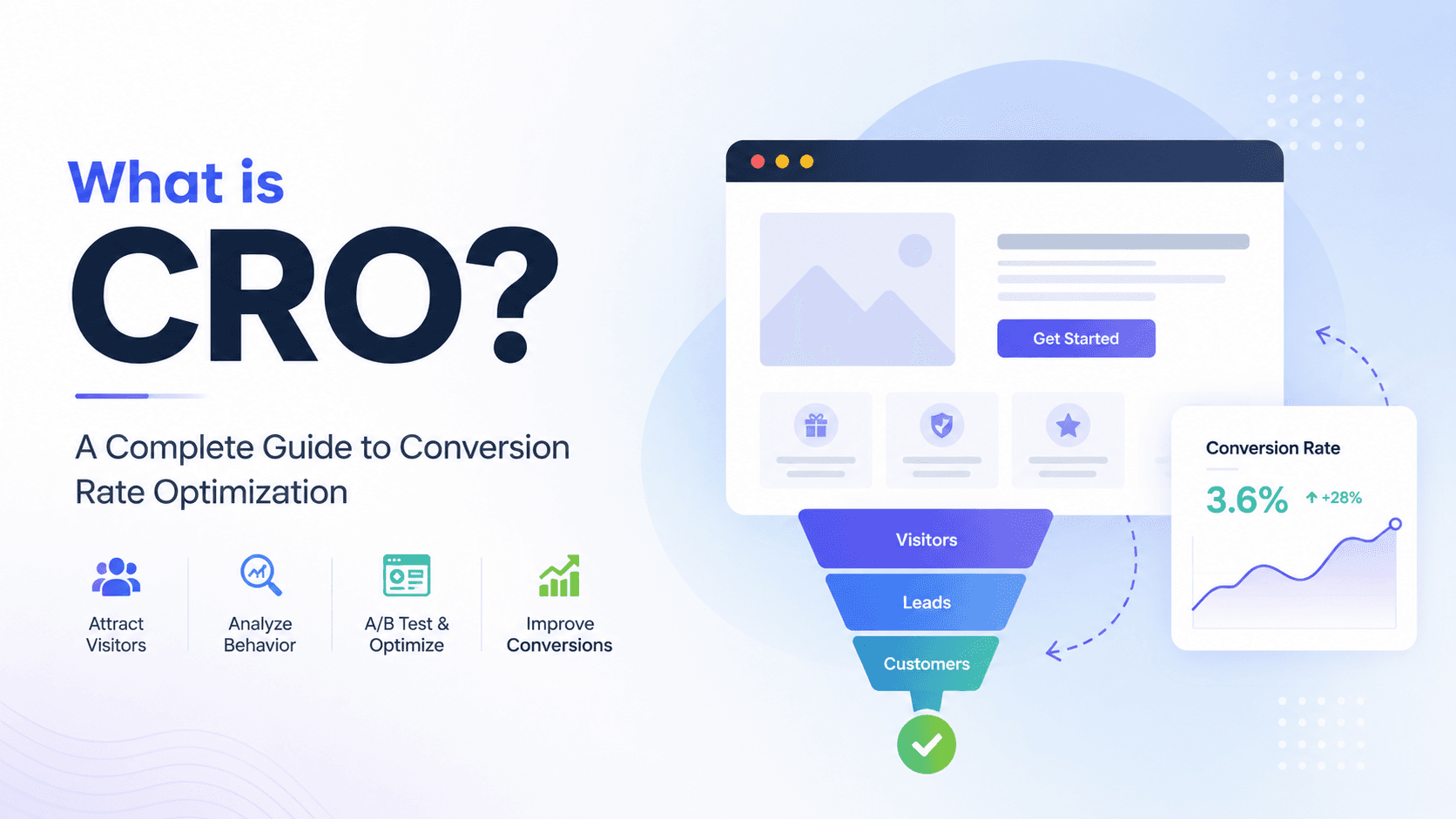
// IN THIS GUIDE
The CRO formula — and what it actually means
The conversion rate formula is simple. What matters is understanding what a “conversion” is for your specific business — and why the percentage is the only metric that tells you whether your page is working.
// CONVERSION RATE FORMULA
Conversion Rate = (Conversions ÷ Total Visitors) × 100
Result expressed as a percentage
// WORKED EXAMPLE
1,000
visitors
20
signups
2%
CVR
A page receiving 1,000 visitors and generating 20 signups has a 2% conversion rate. Improving that to 3% — with no additional ad spend — means 30 signups from the same traffic. That is a 50% increase in leads from the same budget.
What counts as a conversion?
A conversion is any action that matters to your business. The most important rule: optimise each page for one primary conversion goal. Pages chasing multiple goals at once typically convert worse at all of them.
- Purchase — A completed ecommerce transaction or subscription payment
- Free trial start — Beginning a free trial for a SaaS product — the primary goal of most SaaS landing pages
- Lead / enquiry — Form submission, quote request, or contact message
- Signup — Account creation or newsletter subscription
- Download — PDF guide, app installation, or resource download
- Micro-conversion — Clicking a CTA, scrolling to pricing, watching a video — smaller actions that predict conversion
What is a good conversion rate for a website?
There is no universal “good” conversion rate — it depends on the page type, industry, traffic source, and whether you are measuring global or India-specific traffic. These benchmarks are a starting point for assessing where you stand.
// GLOBAL CVR BY PAGE TYPE
// Industry aggregates. Actual rates vary by traffic source, offer, and page quality.
// INDIA-SPECIFIC BENCHMARKS
| Page type | India avg |
|---|---|
| Ecommerce (D2C) | 1–1.5% |
| SaaS free trial | 2–3% |
| Lead gen / enquiry | 3–5% |
| Landing page (paid) | 2–4% |
| Real estate enquiry | 1–3% |
| EdTech trial / signup | 3–7% |
// THE TOP 10% BENCHMARK
For most Indian businesses, moving from 1% to 2% conversion rate on an existing landing page is more achievable — and more profitable — than doubling ad spend.
DTC Conversion Rate Benchmarks 2026: Real Data
What's a good conversion rate in 2026? Ecommerce, SaaS, and lead gen benchmarks — global vs India. Plus why the top 10% of pages convert at 3–5× the average.
CRO for Indian websites: the mobile-first reality
CRO for Indian websites is not the same as CRO for US or European markets. The device landscape, payment infrastructure, trust patterns, and connectivity profile are fundamentally different — and most “global” CRO advice does not account for them. These are the six factors that matter most.
Mobile-first traffic
Over 75% of Indian web traffic comes from mobile devices. A page optimised for desktop but not mobile is already losing the majority of its visitors before they read a single word.
UPI & COD expectations
UPI is used by 350M+ Indians for online payments. Not displaying UPI, GPay, PhonePe, or Paytm icons prominently is a conversion killer. For D2C brands, 60–65% of orders are Cash on Delivery — removing COD typically causes 30–40% drop in conversions.
WhatsApp as trust signal
A visible "Chat on WhatsApp" button increases enquiry conversions by 20–40% on Indian B2C sites. WhatsApp is the default customer service channel for Indian buyers — it signals real humans are reachable.
First-time buyer trust gap
India has a higher proportion of first-time online buyers compared to mature markets. These buyers are significantly more trust-sensitive — testimonials with full names, location, and outcome details convert better than anonymous reviews.
EMI for high-ticket items
For products priced above ₹2,500, showing "EMI from ₹X/month" prominently can increase conversions by 15–25%. Indian buyers respond to breaking the price into monthly instalments far more than global averages.
Tier 2/3 city connectivity
A significant portion of Indian ecommerce growth is coming from Tier 2 and 3 cities where 4G speeds average 15–20 Mbps. Pages above 3 seconds load time on mobile see measurable drop-off before first interaction.
// THE INDIA CRO PRIORITY ORDER
Website Audit Checklist for Indian Businesses (2026)
India-specific audit covering WhatsApp trust signals, UPI payment badges, COD mentions, mobile-first performance checks, and RERA compliance.
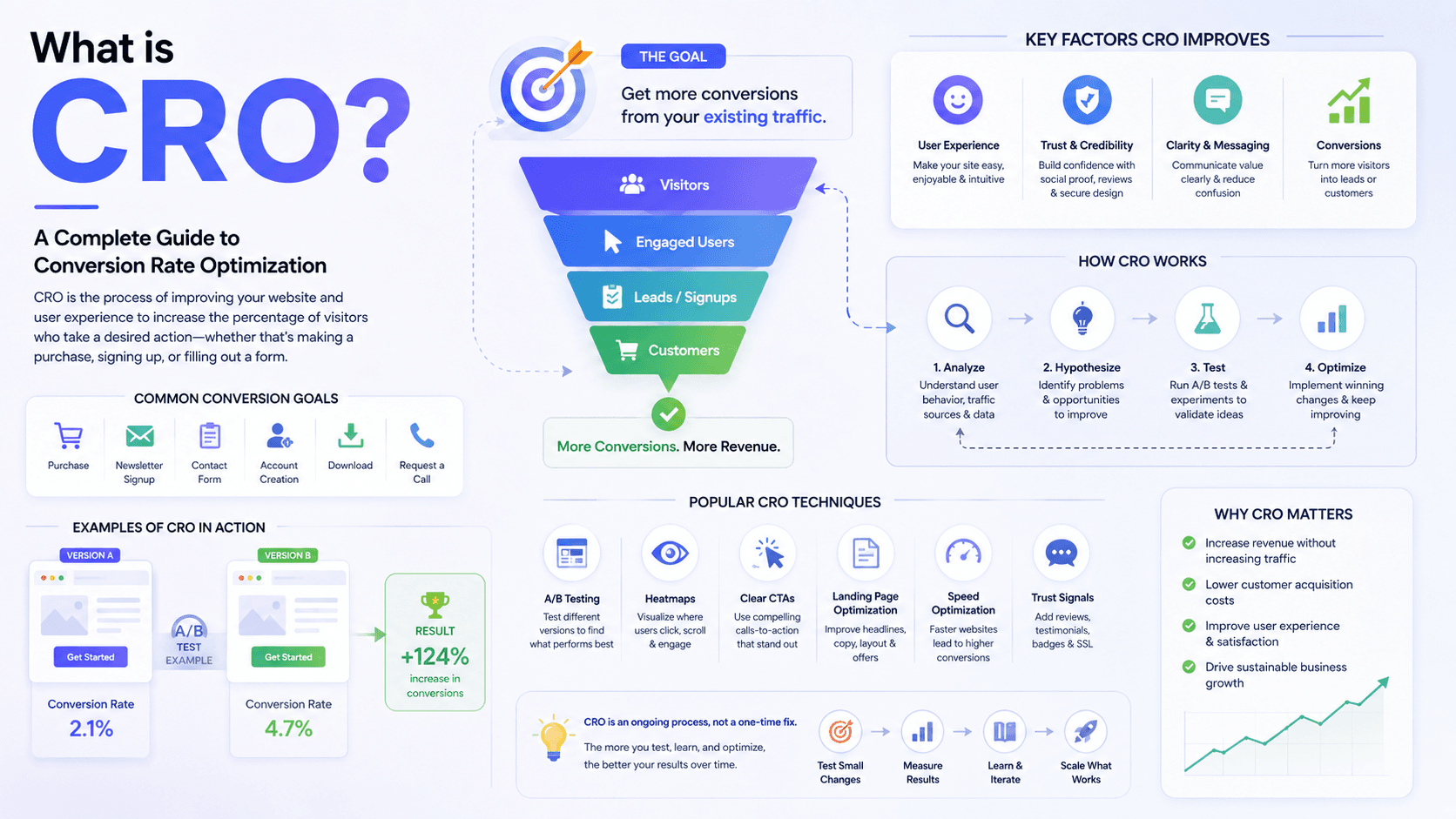
CRO vs SEO vs UX — how they relate
CRO vs SEO
SEO increases the volume of visitors reaching your site by improving your rankings in organic search. CRO increases the percentage of those visitors who complete a desired action. SEO fills the top of the funnel; CRO converts the middle. They are not competing disciplines — they are two levers on the same revenue engine.
The mistake most businesses make: investing in SEO before fixing the page visitors arrive on. Driving 10,000 visitors/month to a 1% converting page is less profitable than driving 5,000 visitors/month to a 3% converting page — and far more expensive. CRO should precede any significant traffic investment.
CRO vs UX
UX design asks: “Is this easy and pleasant to use?” CRO asks: “Does this produce a conversion?” They overlap significantly — poor UX directly hurts conversion rates. The key difference is measurement. UX improvements are evaluated on usability scores and user satisfaction. CRO improvements are evaluated on conversion rate.
A UX improvement that makes the page more beautiful but does not move the conversion rate is not a CRO win. CRO requires a measurable business outcome, not just a better experience.
How all three work together
SEO
Brings the right visitors
UX
Makes the page easy to navigate
CRO
Converts visitors into customers
The most effective websites treat all three as a single system. A page with strong SEO and good UX but weak CRO — no trust signals, buried CTA — consistently underperforms against a page where all three are optimised together.
The 8 areas that affect conversion rate
ClearAudit scores every website across these 8 areas. Each represents a distinct set of factors that directly influence whether a visitor converts or leaves. A weakness in any single area can suppress your overall conversion rate — even if the other seven are strong.
First impression
The above-the-fold section decides whether visitors stay or leave within 5 seconds. A vague headline, cluttered layout, or slow-loading page causes bounce traffic before the visitor has seen your offer. A clear headline + visible CTA above the fold is the single most impactful change most pages can make.
Headline clarity
Your headline is the highest-leverage element on any page. A clear, outcome-focused headline — "Fix what's costing you conversions — free audit in 60 seconds" — outperforms a feature-focused one — "AI-powered website audit tool" — because it speaks to what the visitor wants, not what you built. The test: can a stranger understand your offer in 5 seconds?
CTA effectiveness
The call to action must be visible above the fold, use copy that describes what the visitor gets ("Get My Free Report" not "Submit"), and have sufficient colour contrast to be spotted at a glance. The copy on the button matters more than the button colour. Specific CTAs outperform generic ones by 2–3× in most audits.
Trust signals
Visitors silently ask: "Is this safe to try?" Trust signals answer that question before it becomes a reason to leave. The most effective: specific testimonials with full names and outcomes (not "Great product — J."), a customer count ("2,400 websites audited"), and visible contact information that signals real humans exist behind the product.
Mobile readiness
In India, 75%+ of web traffic comes from mobile. A page optimised for desktop but tested on mobile often has a buried CTA, small tap targets, a form that requires zooming, or horizontal scroll — each of which causes immediate drop-off. Mobile readiness is not optional; it is the baseline.
Speed perception
A page that feels slow destroys trust before a visitor has read a single word. Speed perception covers both actual load time (LCP, measured) and perceived load time (how fast content appears to the user). Pages scoring below 70 on Google PageSpeed mobile lose a measurable percentage of conversions at every additional second of load time.
SEO basics
SEO basics — a descriptive title tag, compelling meta description, clear H1, and proper heading hierarchy — affect not just rankings but click-through rates from search. A well-structured page signals both to Google and to AI models that the content is authoritative and well-organised, which improves both organic traffic and the quality of visitors who arrive.
Conversion flow
The conversion flow is the path from landing on your page to completing the desired action. Every extra step, every unclear instruction, and every unnecessary form field is a point where visitors drop off. The best-converting pages guide visitors toward one clear action with minimal friction — one CTA, not five.
CRO Audit Checklist: 30 Conversion Rate Checks (2026)
30-point checklist across all 8 conversion areas — CTAs, copy, trust signals, mobile UX, speed, and more. Run it on any page in under an hour.
The CRO process: 4 steps that actually work
Most businesses overcomplicate CRO. The highest-impact improvements — clearer headline, visible CTA, stronger trust signals — require no traffic data, no A/B testing infrastructure, and no specialist tools. This 4-step process works for any website at any traffic level.
Audit your page to get a baseline
Before changing anything, audit your current page across the 8 CRO areas. Without a baseline score, you cannot measure improvement — and you risk fixing the wrong things first. A ClearAudit report takes 60 seconds and identifies the 3 critical issues costing you conversions, ranked by impact.
Fix the critical issues first — not the easiest ones
Focus on the highest-impact, lowest-effort fixes: headline clarity, CTA copy and visibility, and trust signals. These are copy changes and minor design tweaks. They can be done in under a day and often produce double-digit conversion rate improvements.
Test your mobile experience on a real Android device
Open your page on an Android phone — the primary device of the majority of Indian internet users — and answer three questions: Is the CTA visible without scrolling? Does the page load in under 3 seconds on a 4G connection? Can you fill out the form without zooming?
Re-audit after every round of changes
CRO is iterative — not a one-time project. Re-audit the page after each round of fixes to confirm improvement and identify the next priority. Track your conversion rate in Google Analytics 4 against a consistent date range.
How to test your CRO changes
Testing is how you confirm that a CRO change actually improved conversion rate — not just that it looked better. The right method depends on your traffic volume. Here are the five most effective approaches.
// WATCH OUT
A/B testing
Best for: 1,000+ monthly visitorsShow version A to 50% of visitors and version B to the other 50%. Measure which converts better over 2–4 weeks. Requires 100+ conversions per variant to reach statistical significance. Start with the element most likely to affect behaviour: the headline.
Heatmap analysis
Best for: any traffic levelClick maps show where users click. Scroll maps show how far they scroll. Session recordings show how real users navigate. Free tools: Microsoft Clarity, Google Analytics 4 (scroll depth). Paid: Hotjar, FullStory. Heatmaps reveal behaviour; CRO explains why.
Session recordings
Best for: diagnosing frictionWatch recordings of real user sessions to see where they hesitate, rage-click, or abandon. Effective for identifying unexpected friction: a confusing form, a broken button, a trust gap that only appears during the session. 20 session recordings often reveal more than a week of analytics.
User surveys
Best for: understanding intentA single survey question at the right moment — "What almost stopped you from signing up today?" — produces insights that no tool can reveal. Run an exit-intent survey on users who do not convert. Qualitative data from 20 responses often beats months of quantitative testing.
Expert audit (for low-traffic sites)
Best for: under 1,000 monthly visitorsA/B testing requires traffic volume to reach significance. Sites with fewer than 1,000 monthly visitors per page cannot reliably run A/B tests. The most effective method: run a structured CRO audit, implement the top recommendations, then measure before vs after conversion rate over 30 days.
// WHAT TO TEST FIRST
- 01Headline copy — the highest-impact element on any page
- 02CTA button copy — "Get My Free Report" vs "Submit" vs "Start Free Trial"
- 03CTA placement — above fold vs mid-page vs multiple CTAs
- 04Trust signals — testimonial placement, customer count, logo bar
- 05Page layout — single column vs two-column, hero image vs no image
Common CRO mistakes — and why they happen
Most websites make the same handful of mistakes repeatedly. These are the seven that appear most frequently — and have the highest conversion cost when left unfixed.
Vague or generic headline
"Welcome to our website" or "We offer quality services" communicates nothing. A visitor has 5 seconds to understand your offer before they leave. A headline that does not immediately answer "what is this, for whom, and why does it matter?" is costing you conversions on every visit.
CTA buried below the fold
If the primary call to action requires scrolling on desktop — or worse, on mobile — you lose every visitor who does not scroll that far. Research consistently shows the majority of conversions happen from above-the-fold CTAs. Secondary CTAs can appear further down; the primary one must be immediately visible.
No social proof
A page without testimonials, review counts, or customer logos asks visitors to take a risk on an unknown brand. Effective social proof is specific: "Our checkout abandonment dropped from 78% to 31% in 6 weeks — Priya R., D2C founder, Bengaluru" outperforms "Great tool!" Every generic testimonial is a missed opportunity.
Too many form fields
Every additional field reduces form completion rates. Asking for phone number, company size, revenue, and team size before a visitor has seen your product creates unnecessary friction. Remove every field you do not need to start the relationship. Phone number is the single highest-friction field — remove it unless you genuinely call leads.
Optimising desktop, ignoring mobile
Designing for desktop and treating mobile as an afterthought is the most expensive CRO mistake in India. A CTA that is invisible on mobile, a form that requires zooming, or a checkout that does not support UPI — each of these is silently destroying the majority of your conversion opportunities.
Running ads to a weak page
Spending ₹50,000/month on Google or Meta ads to drive traffic to a page with a 1% conversion rate means 99% of your ad spend is wasted. Fixing the page first — to 2% conversion rate — doubles your effective return from the same ad budget. CRO should precede any significant paid traffic investment.
Optimising for the wrong conversion
Pages optimising for multiple goals at once — buy now AND sign up AND download AND follow us — typically convert worse at all of them. Identify the one primary conversion action for each page and make every element on that page serve that single goal.
“After auditing 200+ Indian D2C sites, the same three failures show up on almost every homepage losing money to ads: a headline that describes the company instead of the customer's problem, no visible UPI or COD trust marker, and a CTA button that just says 'Submit.' Fix those three and most sites move 15–30% before any A/B test.”
CRO ROI: the business case in real numbers
CRO is one of the highest-ROI marketing investments a business can make because it compounds — every visitor who would not have converted now does, forever, for no incremental ad spend.
// CRO ROI FORMULA
CRO ROI = ((New Revenue − Old Revenue) − CRO Cost) ÷ CRO Cost × 100
Revenue uplift = (New CVR − Old CVR) × Monthly Visitors × Average Order Value
// WORKED EXAMPLE — D2C BRAND
// BEFORE CRO
// AFTER CRO
// WHY CRO ROI COMPOUNDS
How much does CRO cost in India?
CRO costs range from ₹199 for a single AI audit to ₹3,00,000/month for a full-service agency retainer. The right approach depends on your traffic volume, team capacity, and how fast you need results.
| Approach | India cost |
|---|---|
| AI audit tool (ClearAudit) | ₹199–₹999/audit |
| Freelance CRO consultant | ₹15,000–₹60,000/mo |
| CRO agency retainer | ₹60,000–₹3,00,000/mo |
| Enterprise platform (VWO, Optimizely) | ₹40,000–₹3,00,000/mo |
| Full in-house CRO team | ₹3,00,000–₹8,00,000/mo |
// THE 80/20 OF CRO SPENDING
// QUESTIONS
Common questions.
Frequently asked questions
What is conversion rate optimisation (CRO)?
Conversion rate optimisation (CRO) is the process of increasing the percentage of website visitors who complete a desired action — making a purchase, signing up, or submitting an enquiry. It works by identifying and removing the specific barriers stopping visitors from converting: unclear headlines, buried CTAs, missing trust signals, poor mobile experience, or unnecessary friction in the conversion flow. CRO improves revenue from existing traffic without increasing ad spend.
What is a good conversion rate for a website in India?
Conversion rates in India tend to run slightly below global averages due to higher mobile traffic share, greater trust sensitivity among first-time buyers, and a higher proportion of users in lower-bandwidth environments. Ecommerce pages in India average 1–1.5% conversion rate (global average: 2–3%). SaaS free trial pages: 2–3%. Lead generation pages: 3–5%. The top 10% of pages in any category convert at 3–5 times the average — primarily because they have been systematically audited and improved. For most Indian businesses, moving from 1% to 2% conversion rate is more achievable and more profitable than doubling ad spend.
What is the difference between CRO and SEO?
SEO (Search Engine Optimisation) increases the volume of visitors reaching your site by improving your rankings in search results. CRO increases the percentage of those visitors who complete a desired action. SEO fills the top of the funnel; CRO fixes what happens after visitors arrive. They work on different parts of the same system and produce the best results when run together. Running SEO on a page that does not convert is expensive — every visitor you pay to acquire who does not convert is wasted budget. CRO should precede any significant traffic investment.
Is CRO the same as A/B testing?
No. A/B testing is one method within a broader CRO process. CRO includes diagnosing what is wrong (via audits, heatmaps, and session recordings), forming hypotheses about what to change, implementing changes, and measuring the results. A/B testing is the step where you test two versions of a change against each other. Many CRO improvements — especially fixing headline clarity, CTA visibility, or mobile usability — can be implemented and measured without A/B testing, especially on low-traffic sites.
How do I improve my website's conversion rate?
Start with an audit to identify what is specifically wrong. The highest-impact improvements are: (1) Clarify your headline so the value proposition is obvious in 5 seconds. (2) Make the CTA visible above the fold with specific copy — "Get My Free Audit" not "Submit". (3) Add trust signals: testimonials with full names and outcomes, customer counts, visible contact info. (4) Fix the mobile experience — test on a real Android device. (5) Remove unnecessary form fields. Each of these can be implemented without a developer in most cases and typically produces double-digit conversion rate improvement.
What is a CRO audit?
A CRO audit is a structured review of a web page to identify what is stopping visitors from converting. It evaluates headline clarity, CTA effectiveness, trust signals, mobile experience, page speed, copy quality, social proof, and conversion flow. A manual CRO audit by a specialist takes 2–5 hours per page. ClearAudit runs an AI-powered CRO audit in 60 seconds — returning scored findings across 8 areas with specific, actionable recommendations for each.
How long does CRO take to show results?
Results depend on the type of change and your traffic volume. Copy changes and CTA improvements (highest-impact, lowest-effort fixes) can show measurable results in 1–2 weeks at moderate traffic levels. A/B tests typically require 4–8 weeks to reach statistical significance. The fastest path to results: run an audit, implement the top 3 critical fixes in a day, then measure before vs after over 30 days. For most Indian businesses, this approach produces a measurable improvement in conversion rate within the first month.
Does CRO work for small websites with low traffic?
Yes — but the method changes. A/B testing requires statistical significance, which demands traffic volume (typically 1,000+ monthly visitors per variant). Small sites should use expert audits, heatmaps, and session recordings instead of A/B tests. A ClearAudit report identifies the top critical issues regardless of traffic level — and fixing a broken CTA or vague headline on a 500-visitor/month site can double leads overnight without any A/B testing infrastructure.
What tools do I need for CRO?
The minimum effective CRO toolkit: (1) An audit tool to diagnose current issues — ClearAudit for CRO-specific diagnosis. (2) Google Analytics 4 to measure conversion rate and track changes over time. (3) Microsoft Clarity (free) for heatmaps and session recordings. (4) An A/B testing tool if traffic allows — Google Optimize alternatives include VWO (Indian pricing available) or Optimizely. Most businesses spend too much on tools and too little on implementing findings. An audit + Google Analytics + Clarity covers 80% of what most sites need.
What is a micro-conversion in CRO?
A micro-conversion is a smaller action that moves a visitor toward the primary conversion goal — clicking the CTA, scrolling to the pricing section, watching a product video, or adding to cart. Micro-conversions matter because they reveal where visitors are engaging and where they drop off before converting. Optimising for micro-conversions — getting more visitors to click the CTA even if they do not immediately convert — is often the fastest path to improving macro-conversion rates.
// UPDATE HISTORY
Last updated: May 28, 2026
3 versionsMay 28, 2026Major update
- Added hero image, audio overview, and video overview
- New section: CRO for Indian websites — UPI, COD, WhatsApp, EMI, Tier 2 connectivity
- New section: CRO testing methods — A/B, heatmaps, session recordings, user surveys
- New section: CRO ROI calculator with worked ₹ example (1.5% → 2.5% CVR)
- New section: How much does CRO cost in India — 5-tier breakdown
- Expanded FAQ from 5 to 10 questions covering micro-conversions, low-traffic sites, tools
- Visual benchmark bar chart with 6 page types
- India-specific benchmark table with 6 categories and key conversion drivers
- Sticky sidebar TOC with active section tracking on scroll
- Reading progress bar, social sharing (WhatsApp, Facebook, LinkedIn, Email, Copy link)
May 1, 2026Content update
- Updated India-specific conversion benchmarks for 2026
- Added Shopify CRO audit reference and D2C checkout drop-off data
- Improved mobile readiness section with India traffic statistics
- Added HowTo schema for 4-step CRO process
January 1, 2026Published
- Initial publication: CRO formula and worked example
- Conversion rate benchmarks by page type
- CRO vs SEO vs UX comparison
- The 8 areas that affect conversion rate
- Common CRO mistakes and 4-step getting started guide
- FAQ with 5 questions, Article + BreadcrumbList schema
// VIDEO OVERVIEW
// A quick visual summary of everything covered in this guide.
// CRO FUNDAMENTALS — FULL SERIES
// RELATED GUIDES
Why Indian D2C Brands Lose 70% at Checkout
6 causes of checkout abandonment and how to fix each without a developer.
Best Website Audit Tools for Indian Businesses
The 7 best tools ranked by what they actually audit — CRO, technical SEO, and performance.
Free Website Audit Tool
Audit any URL in 60 seconds. 2 free audits, no credit card required.
AI CRO Tools: What They Can and Can't Do
How AI-powered CRO tools work, what separates good from bad analysis.
// WRITTEN BY

5 years building DTC & Shopify stores. Founded EcomLifters. Built ClearAudit.